
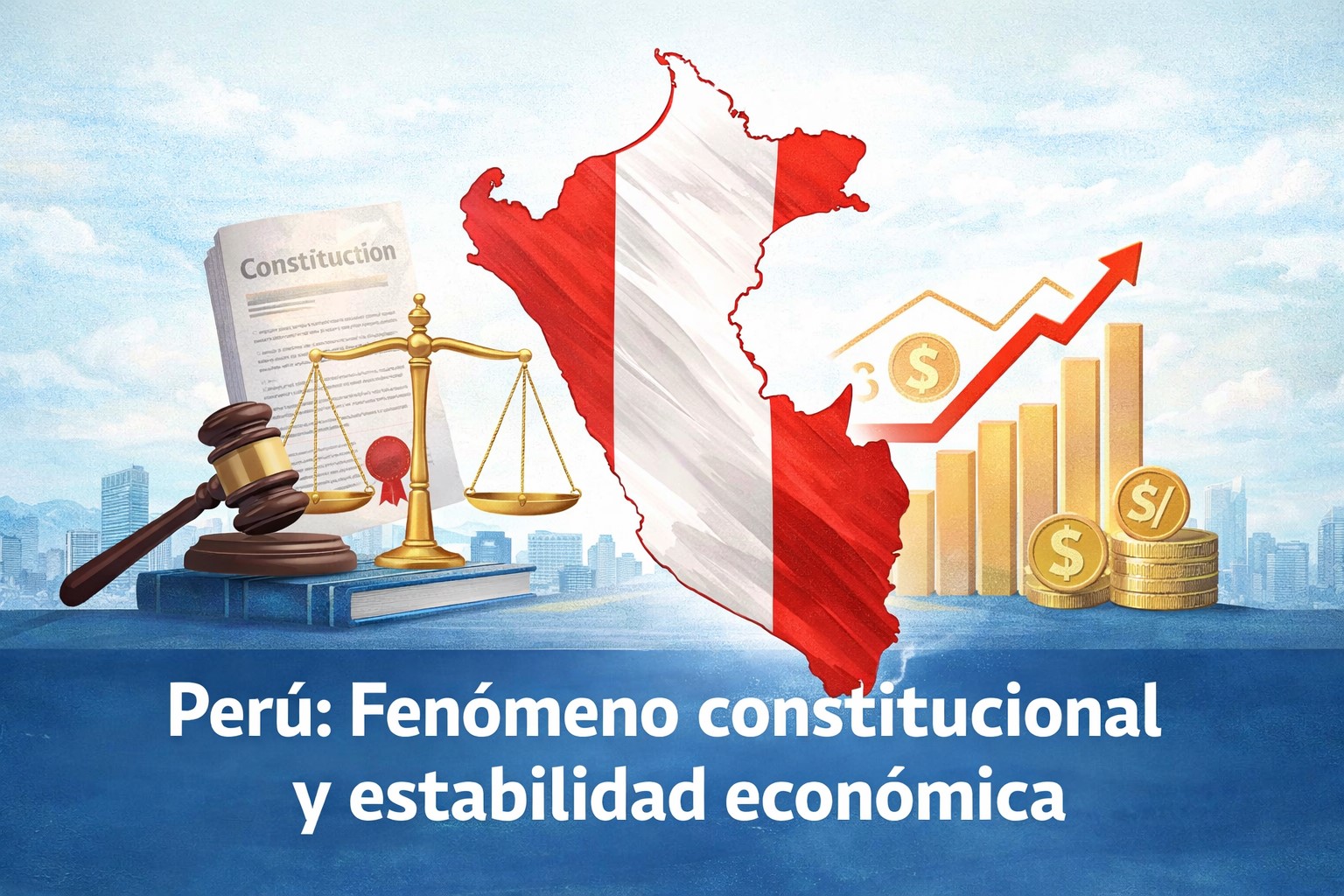
This paper presents a formal analysis of the Peruvian system of government, based on the national legal framework and, in particular, the 1993 Political Constitution of Peru. This text incorporates guarantees for the protection of foreign investments and demonstrates the influence of continental European constitutionalism, enshrining a social market economy model with a liberal orientation.
At the organizational level, the Constitution formalizes a reinforced presidential system of government and integrates mechanisms of political control, typical of parliamentarianism. This is expressed in institutions such as the Ombudsman’s Office and the presence of the Constitutional Court.
However, successive constitutional reforms—such as the elimination of immediate reelection (2000) and reforms to the election of members of the Constitutional Court—have generated structural changes in Peru that have consolidated the economic model and strengthened and protected the autonomy of the Central Reserve Bank. In other words, monetary policy is constitutionally guaranteed, creating an island of state efficiency that transcends political turbulence.
At the same time, the dynamics of the government system have granted increasing prominence to the Congress of the Republic, which in reality has caused the formality of a presidential system to evolve into a more attenuated presidentialism, with the strengthening of institutions incorporated from and originating from parliamentarism. Consequently, in reality, this has resulted in a semi-presidential system that has been eroded. This constitutional transition has created pockets of institutional efficiency, such as the Ministry of Economy and Finance, the Tax Administration, and the consumer protection agency, INDECOPI. Strategic ministries like the Ministry of Foreign Affairs, along with the Ministry of Foreign Trade and Tourism, have promoted the signing of international treaties and agreements.
This policy has contributed to diversifying Peru’s export offerings in the mining, metallurgical, and agricultural sectors, incorporating national assets such as its culture and gastronomy. This process has allowed for the development of an international integration model based on geoeconomic diversification and open multilateralism, avoiding rigid alignments with specific powers.
Consequently, this strategy has contributed to maintaining relative strategic autonomy, expanding export offerings, and reducing vulnerabilities to global systemic crises, strengthening macroeconomic resilience through the signing of international treaties and the consolidation of a constitutional economic regime oriented towards free trade. Furthermore, the oversight institutions and the Judiciary, which guarantees the administration of justice, along with the legally binding contracts that ensure the legal stability of investments, have all generated incentives for building institutional capacity and ultimately granting economic stability to Peru. This contrasts with a constant in the global landscape, where, in various systems of government, the political credibility and legitimacy of authorities fade during political crises with economic consequences. Peru, however, despite frequent changes in the highest authority, has had several presidents imprisoned. For investors, the message is clear: Congress must safeguard the pockets of efficiency (technical autonomy and meritocracy) and maintain predictable rules. If the president fails to provide answers, constitutional mechanisms should be used to replace him in an orderly and legal manner, without damaging the institutional continuity that sustains trust, credibility, and investment.